







Updating Academic Curricula to Strengthen Skills in the Green and Blue Economies: An Integrated Capacity-Building Pathway in Libya under the EU4Skills Project
The EU4Skills project continues to implement a comprehensive set of activities aimed at supporting the development of higher, technical, and vocational education in Libya, with a strong focus on updating academic curricula and aligning them with labor market needs, particularly in the green and blue economy sectors. These activities aim to enhance the readiness of educational institutions to deliver modern, flexible, and skills-based programs that are aligned with global economic and environmental transformations.
These initiatives bring together workshops, technical sessions, academic discussions, and capacity-building programs, with the participation of faculty members, academics, and experts from several Libyan universities and technical colleges. They focus on reviewing existing academic programs, identifying skills gaps, and integrating concepts of sustainability, renewable energy, resource management, and digital transformation into curricula, thereby strengthening the link between theoretical knowledge and practical application within academic institutions.
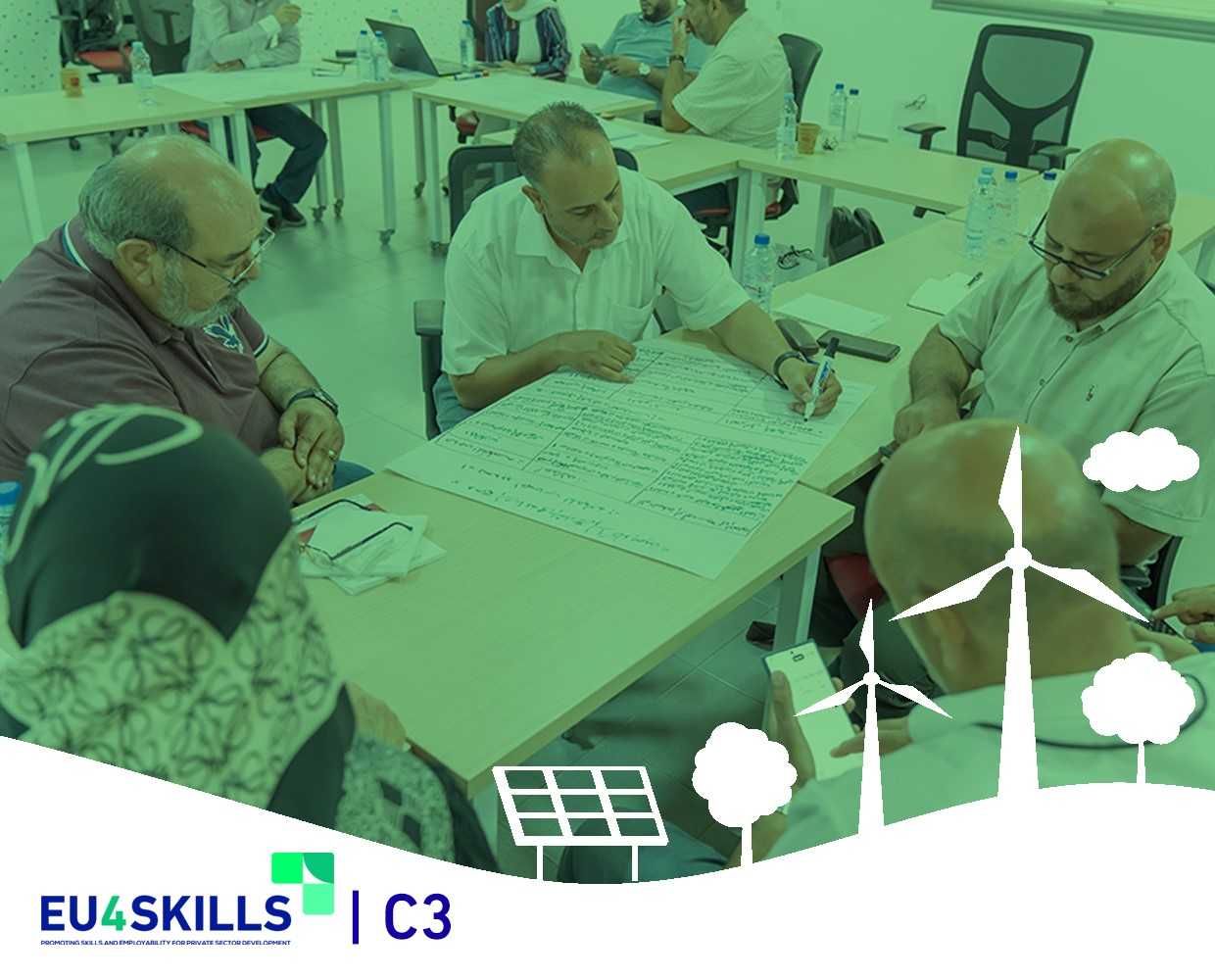
For instance, a workshop was recently held on February 7, bringing together relevant stakeholders involved in curriculum development and teaching methodologies and quality requirements in the fields of water and agriculture across Libyan universities. The workshop served as an effective platform for exchanging insights and expertise and for establishing practical foundations to update academic programs in line with current and future challenges.
As part of strengthening this trajectory, over several months, an academic cooperation program was implemented with ESPRIT University in Tunisia, focusing on building the capacities of faculty members through hands-on training sessions covering modern teaching methodologies, digital technologies, and the integration of artificial intelligence in education. This collaboration has equipped participants with practical tools that support curriculum modernization within their institutions and enhance their ability to design academic content that is more closely aligned with labor market needs.
This cumulative approach contributes to building an enabling academic environment for curriculum reform by connecting Libyan universities to international expertise networks, fostering knowledge exchange, and strengthening faculty capacities, ensuring that curriculum modernization is a sustained process rather than a phased intervention.
In this context, a study tour to Italy will be organized during April as an extension of these efforts, with the participation of representatives from several Libyan universities and technical colleges, including the University of Tripoli, the University of Benghazi, the University of Zawiya, and the University of Wadi Al Shati, as well as specialized technical institutions in the fields of energy and technology, including the Misrata Industrial Technical College, the Tajoura Renewable Energy College, and the Jikharra Energy Technologies College. The visit will provide an opportunity to explore advanced experiences in designing and updating academic curricula and linking education with scientific research and practical application in the fields of renewable energy and sustainability. It will also include in-depth discussion sessions, academic presentations, and research laboratory visits aimed at exchanging expertise on best practices in developing educational programs and building modern learning models.
In addition, participating faculty members will work in the coming months to transfer the knowledge and expertise gained by implementing specialized training programs within their institutions, under the academic supervision and guidance of ESPRIT University. These initiatives aim to ensure the sustainability of the project’s impact and to strengthen a culture of continuous learning within the university environment by enabling a greater number of academic staff to adopt modern, innovative, and participatory teaching approaches.
The EU4Skills project is funded by the European Union in partnership with the French government and implemented by Expertise France in collaboration with Libyan partners, aiming to support the development of higher, technical, and vocational education in Libya and strengthen its role in promoting sustainable development and creating diverse employment opportunities.