







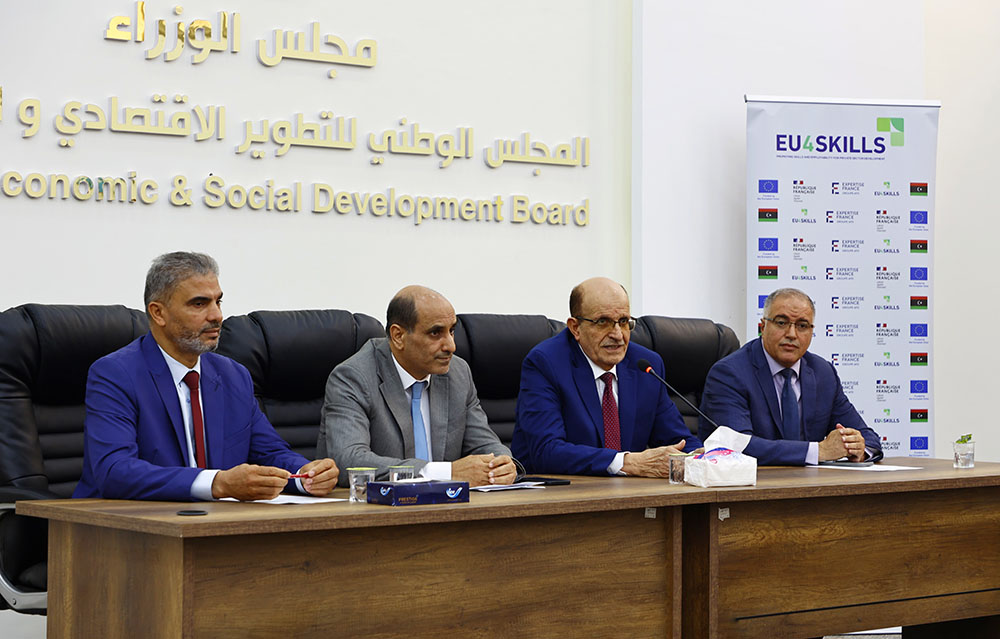
Workshop on developing financial and accounting education and linking it to the labor market
On Monday, July 13, 2026, the National Economic and Social Development Board hosted a workshop on developing financial and accounting education and linking it to labor market needs. The workshop brought together a select group of representatives from ministries and national institutions in the financial and banking sectors, along with academics, experts, and specialists in the fields of finance, education, and accounting.
This workshop was organized in cooperation with National Economic and Social Development Board and the National Program for the Development of the Accounting Profession, and implemented by Expertise France, as part of the EU4Skills project. Funded by the European Union and co-financed by the French government, the project aims to enhance the alignment of education and training outcomes with labor market needs, thereby contributing to skills development and increased employment opportunities.
The workshop opened with a speech by Dr. Mahmoud Al-Futaisi, Chairman of the National Economic and Social Development Board, who emphasized the importance of strengthening partnerships between educational institutions and economic development stakeholders to ensure the preparation of qualified national personnel capable of meeting the evolving demands of the labor market. Opening remarks were delivered by Dr. Saleh Al-Ghul, Deputy Ministry of Higher Education and Scientific Research; Dr. Abdul Salam Al-Awad, Head of the National Program for the Development of the Accounting Profession; and Dr. Nouri Al-Qattati, Deputy Ministry of Economy and Trade for Free Zones Affairs.
The workshop included a presentation on the EU4Skills and Invest4Libya projects and their objectives in supporting the development of the education and training system in Libya and bolstering the financial and accounting sector by enhancing the alignment of educational programs with labor market needs.
Participants also took part in two panel discussions that addressed the current state of financial and accounting education in Libya, the challenges of aligning its outcomes with labor market demands, and ways to develop curricula, modernize teaching methods, and enhance practical training.
The workshop concluded with a closing session during which the most prominent points raised during the discussions were reviewed, the outputs were summarized, and a set of initial recommendations was formulated that will contribute to supporting efforts to develop financial and accounting education and enhance its connection to the needs of the labor market, in order to support building qualified national competencies capable of keeping pace with the requirements of economic development in Libya.